

If your child has been diagnosed with autism spectrum disorder (ASD), you may wonder if they will experience certain limitations in life. On the contrary, many children with ASD who were once told they would never speak or walk have gone on to achieve greatness in many fields, including athletics. Below are a few remarkable stories of athletes with ASD.
Tony Snell

Professional basketball player Tony Snell always felt different growing up. As a shy, tall kid in South Los Angeles, Snell recalls spending hours a day shooting baskets.
Snell was selected as the 20th overall pick by the Chicago Bulls in the 2013 NBA draft. Throughout his NBA career, he also played for the Milwaukee Bucks, Detroit Pistons, Atlanta Hawks, Portland Trail Blazers and New Orleans Pelicans. He played for several NBA G League teams and currently plays overseas in the LNB Elite league in France.
In 2023, after noticing his eldest son was missing some developmental milestones, Snell and his wife Ashley had him tested for ASD at 18 months old.
After receiving their son’s diagnosis, the TODAY Show described it as a lightbulb going off for Snell. “I was always independent… I just couldn’t connect with people on the personal side of things, and I’m like, ‘You know what, if he’s diagnosed, then I think I am too.’ So that gave me courage to go get checked up,” Snell recalled. He received his ASD diagnosis at the age of 31.
Snell continues to advocate for undiagnosed children growing up in inner city communities, in addition to partnering with the Special Olympics. He and his wife created the Tony Snell Foundation to help minorities gain access to testing for ASD.
Jessica-Jane Applegate
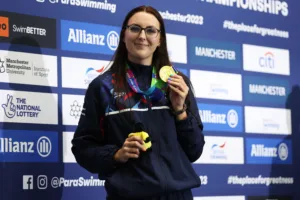
Jessica-Jane Applegate is a British Paralympic swimmer who competes in the S14 category for athletes with intellectual disabilities.
From an early age, Jessica struggled with learning and development, in addition to needing multiple surgeries on her feet and throat. Applegate found a sanctuary for her struggles in the water. “It’s a feeling of peace, happiness and silence… It was somewhere I could escape,” she recalls. “Many times, people think I am racing people who are more severely disabled than I am. It is very hard to explain how even having a normal conversation can be very
hard.”
She has earned 42 medals in national and international events, including two gold Paralympic medals – one in the London 2012 women’s 200m freestyle S14 event and one in the Tokyo 2020 mixed 4x100m freestyle S14 event. She has also set four world records.
Clay Marzo
Growing up in Hawaii, young Clay Marzo lined up seashells in a ridge pattern on the beach. When stressed, he would twirl and pull out large clumps of his hair. Today, he is known for his unique style of turns and spins.
On land, Marzo can struggle with communication, has difficulty connecting with fans and has a sense of bluntness that some people find off-putting. His surfing sponsor Quiksilver believed in his abilities so much they financed a film about him – Just Add Water (2009). The director of the film, Jamie Tierney, whose parents are both psychologists, picked up on his behavior and suspected something more. He was shortly after diagnosed with ASD.
At only 11 years old, Marzo placed third in the National Scholastic Surfing Association (NSSA), which led to his first professional surfing contract with Quiksilver. At age 15, he became the first surfer to receive two perfect 10 scores in NSSA history and claimed the national title. He has also received nominations for several surfing awards.
In the water, Marzo becomes a different person than how he is on land. Nine-time world surfing champion Kelly Slater has said, “Clay does things people don’t even think of. He has his own way of seeing the waves.” His ASD is a crucial part of his success, allowing him to focus for hours at a time on perfecting his craft. The Real Spectrum blog describes his story as “a powerful reminder that when we embrace neurodiverse ways of thinking and being, we expand our understanding of what success looks like.”
Maxim Behavioral
The stories of Tony Snell, Jessica-Jane Applegate and Clay Marzo remind us that ASD does not define limits, it reveals unique strengths. At Maxim Behavioral, we believe in celebrating every individual’s potential, especially those navigating life with ASD. Whether it’s through applied behavior analysis (ABA), compassionate care or community partnerships, our team is committed to supporting children and families as they discover their own paths to success.
