
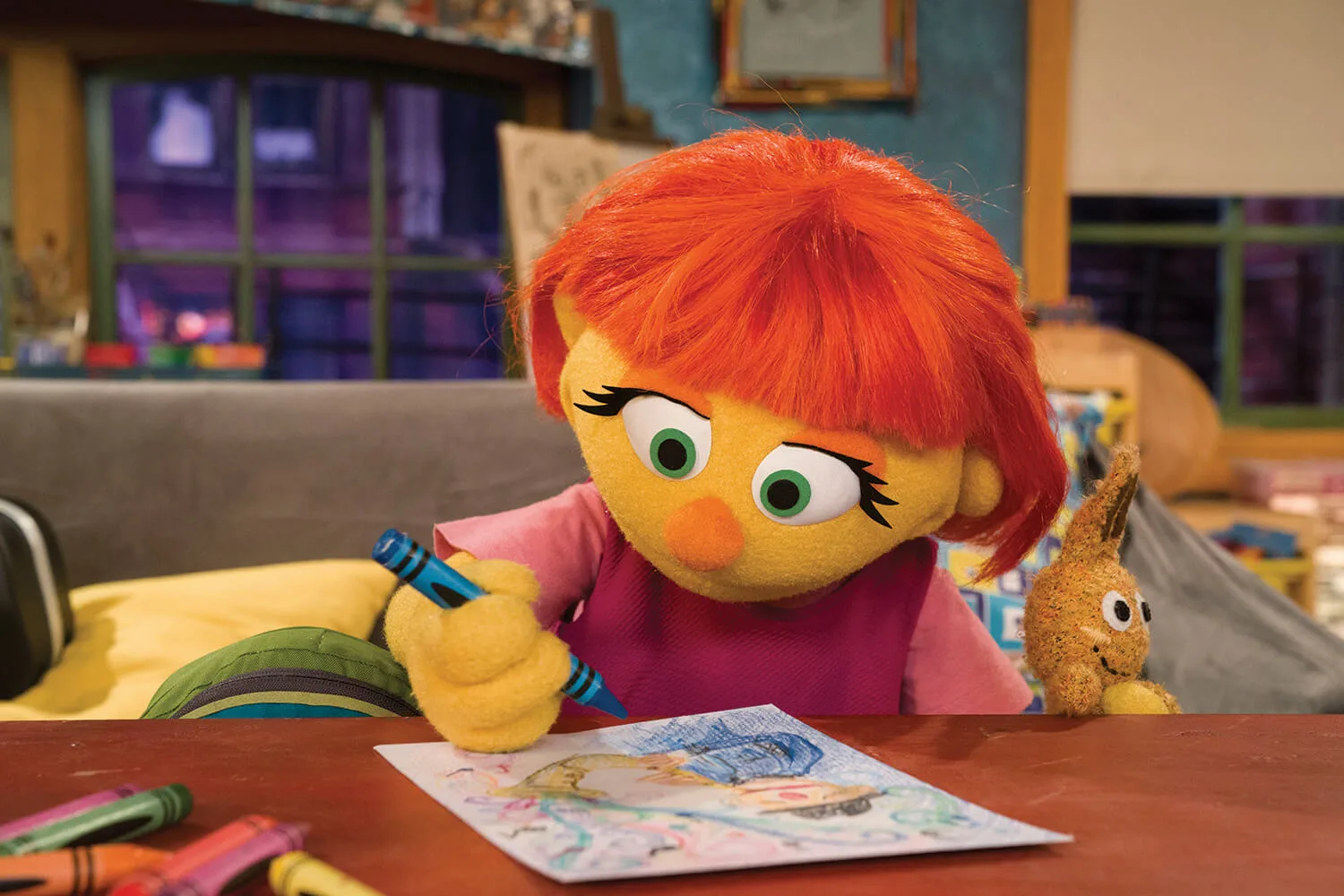
Screen time is a real part of family life, and it can do more than keep kids occupied. The right show gives a child with autism spectrum disorder (ASD) something genuinely valuable: a character who feels like them, in situations they recognize, handled in ways that make sense. And for brothers, sisters, and friends who are watching too, seeing an autistic character treated with warmth and respect on screen can quietly shift the way they understand the people around them.
At Maxim Healthcare’s behavioral division (“Maxim Behavioral”), we put together a short list of shows worth adding to your family’s rotation. Each one features autism representation that was created with real care and real community input. We have organized them by age so you can find the right match for where your child is right now.
Sesame Street featuring Julia
Ages: 2–6 | Where to watch: PBS Kids, YouTube
If your child is still in the preschool years, Julia is the place to start. She is a four-year-old Muppet with bright orange hair, a beloved toy rabbit named Fluffster, and a way of doing things that is, as Elmo puts it, “a Julia sort of way.” She does not always respond right away. Loud sounds can upset her. She processes the world differently, and her friends on Sesame Street do not treat that as a problem. They just love her. Sesame Workshop spent three years developing Julia with input from autism researchers, clinicians, and families before she ever appeared on screen, and it shows. She was the first autistic character in Sesame Street’s history when she debuted in 2017, and she remains one of the most carefully crafted.
What makes Julia particularly powerful for families is the research behind her impact. A study from Georgetown University Medical Center and Children’s National Health System found that parents of both autistic and neurotypical children came away from Sesame Workshop’s autism materials with more knowledge, more acceptance, and, for parents of autistic kids specifically, more hope. Research cited by Neurolaunch also notes that Julia’s portrayal is closer to how autism actually presents in the real population than most media characters, which means what your child sees on screen is genuinely reflective of their experience. Julia’s episodes are also available in Spanish, a meaningful detail for bilingual families.
Pablo
Ages: 3–7 | Where to watch: BBC iPlayer, Universal Kids
Pablo is a five-year-old boy who is largely nonverbal in daily life. When something feels too big to handle, like a noisy birthday party or a surprise haircut, he picks up his magic crayons and draws his way into an animated world where his animal friends help him figure out what he is feeling and what to do next. Each animal character represents a different way autism can show up, so the show never suggests there is just one version of the experience. What makes Pablo especially special is who made it: the entire voice cast is autistic, and people on the spectrum co-write every episode. It is not a show about autism made by people observing from the outside.
Creator Gráinne McGuinness said the show’s goal was to help young viewers understand what it feels like to see the world from an autistic perspective. For children with ASD, Pablo can feel like looking in a mirror. For siblings and classmates, it builds the kind of quiet empathy that no lesson plan quite manages to teach. Common Sense Media called it an illustrative journey into some of the challenges of autism, gently presented. It is available in the U.S. on Universal Kids and globally through the BBC.
Carl the Collector
Ages: 4–8 | Where to watch: PBS Kids
Carl the Collector is the newest show on this list and one of the most exciting. When it debuted on PBS Kids in 2024, it made history as the first PBS Kids series with an autistic lead character. Carl is a raccoon with a passion for collecting things, and his world is full of friends who each bring something different. His friend Lotta, a fox, is also autistic and is sensitive to loud sounds, certain smells, and specific food textures, a detail that will feel immediately familiar to many families. The show was built from the ground up with neurodiverse writers involved. As the Organization for Autism Research noted, creator Zachariah OHora hoped Carl would help neurodiverse and neurotypical kids alike grow up in a world where difference is something to celebrate, not explain away.
What we love about Carl the Collector is that it does not treat autism as the plot. It treats Carl as the hero. He has friends, adventures, and a full life, and his way of moving through the world is simply part of who he is. For young children with ASD, that framing matters. And the show’s predictable structure and warm tone make it comfortable viewing, not just for the lesson it teaches but for how it feels to watch.
Atypical
Ages: 13+ | Where to watch: Netflix
For families with teenagers, Atypical is worth a family watch. It follows Sam Gardner, a 17-year-old on the autism spectrum who wants to date, get into college, and figure out who he is, which turns out to be exactly as complicated as it sounds for anyone his age. Sam is funny, specific and fully realized. His family is messy and loving. The show ran for four seasons on Netflix from 2017 to 2021, and it gets better as it goes, partly because later seasons brought more autistic writers and consultants on board.
It is worth knowing that Atypical received some criticism early on for not involving enough autistic people in its production, and that is a fair point to keep in mind. The show is not a perfect or comprehensive portrait of autism, and it was never trying to be. But that is actually what makes it a great conversation starter. Watching together and talking about what rings true, what feels off, or what makes your teenager laugh can open up conversations that are hard to start any other way. Many families find Sam’s desire to be independent while still needing support deeply, quietly familiar.
Why representation matters
Something happens when a child sees themselves in a story. It is hard to put into words, but parents who have watched a child with ASD light up at a character who flaps their hands, or cover their ears during the same scene their child always covers theirs, know exactly what we mean. It matters. Research from Georgetown University and Children’s National Health System confirmed that autism-focused media builds knowledge and acceptance in families across the board, for autistic children and their siblings alike.
Pay attention to what your child responds to when you watch together. If they get excited about a specific character, a repeated phrase, or a particular scenario, mention it to your child’s Board Certified Behavior Analyst (BCBA). What a child loves on screen can become a bridge into conversation, social storytelling, and communication work in applied behavior analysis (ABA) therapy.
At Maxim Behavioral, we are always looking for ways to meet your child where they are. If you’re looking for guidance or want to learn more about ASD supports available through Maxim, don’t hesitate to reach out to your local office for more information.
