
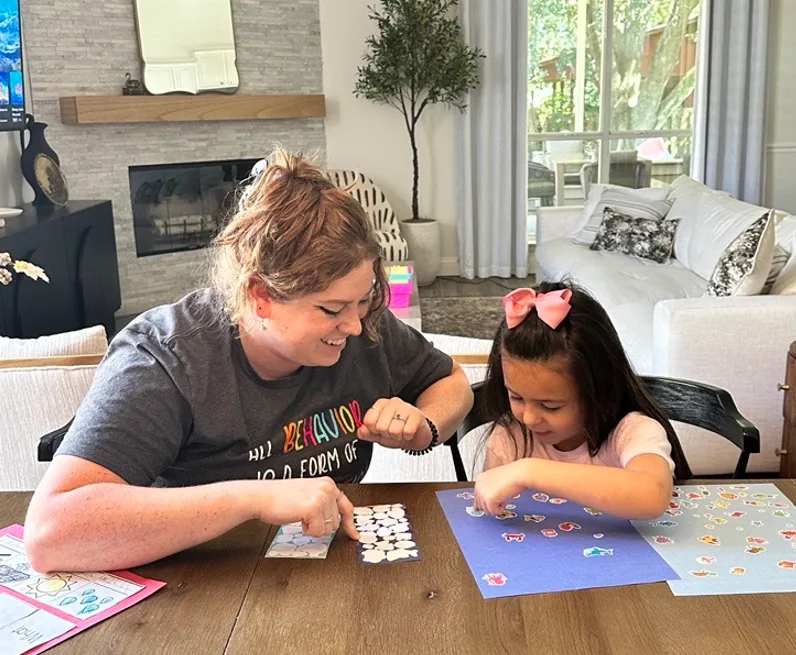
How helping others became a meaningful career for Mary Venne
For Mary Venne, a Registered Behavior Technician (RBT) in Maxim Healthcare’s Jacksonville, Florida office, supporting children has always felt like a natural calling. Long before she entered the field of Applied Behavior Analysis (ABA), she was the oldest cousin at family gatherings, helping supervise younger children and later babysitting throughout high school and college.
Today, Mary combines her passion for helping others with a data-driven approach to care, empowering children to build skills, communicate their needs, and advocate for themselves.
“I’ve always been a bit of an entertainer and had a big role at family gatherings growing up as the oldest cousin to occupy and supervise six other kids,” Mary shared. “I babysat for half of my neighborhood in high school, too.”
After earning a psychology degree from the University of North Florida, Mary spent time working as a restaurant server and trainer while exploring career paths. She considered both education and psychology but ultimately found her passion in behavioral health.
When reflecting on why she chose this profession, five key reasons stand out.
1. Making a meaningful difference in children’s lives
At the heart of Mary’s work is the opportunity to support children one-on-one and witness life-changing moments firsthand.
“I love working one-on-one with individual kids, even if they’re part of a larger group at a school or daycare,” Mary said. “The best parts of my career have been moments where I see a person expressing a need or advocating for themselves independently when they couldn’t before.”
For Mary, those moments represent much more than progress on a treatment plan. They reflect a child’s growing confidence, independence, and ability to navigate the world around them.
2. Combining compassion with science
Mary’s interest in behavior analysis began while babysitting children who struggled with routines and behavior challenges. Wanting to better support them, she began researching evidence-based approaches to behavior management.
“When I was babysitting in high school and college, I worked with a few kids who really struggled around bedtime and started looking into scientifically supported approaches to de-escalating, incentivizing, and managing behavior,” she explained.
As she learned more about ABA, she was drawn to its evidence-based foundation.
“I felt inspired by the data-driven approach (love me some stats), teamwork between professionals, and need for neurodivergent advocates with empathy for the lived experience of individuals in need of behavior support.”
For Mary, ABA provides a balance between compassion and clinical effectiveness.
“I appreciate the science of Applied Behavior Analysis and that what I’m doing isn’t guesswork. It’s clinically supported and objectively defined.”
3. Advocating for neurodivergent individuals
As a neurodivergent individual herself, Mary brings a unique perspective to her work.
“I’m neurodivergent myself, and the idea of normalizing support systems for individuals with disabilities in a way that included their opinions into treatment was too tempting to pass up.”
Throughout her career, she has become passionate about helping clients feel respected, heard, and included in their own care.
Before becoming an RBT, Mary spent considerable time learning about both the history of ABA and the experiences of individuals who had received services. While she initially had concerns about working with a vulnerable population, education helped her better understand the evolution of the field.
“I listened to autistic people talk about their experiences with ABA and how they felt the profession and science could improve and learn from the past,” she said. “More knowledge helped me understand the nuances and made me want to continue improving how the science of ABA is implemented in a supportive, non-restrictive way.”
4. Learning and growing alongside other professionals
Another reason Mary values her career is the opportunity to collaborate with a multidisciplinary team dedicated to helping children succeed.
“I like working alongside other professionals (OT, PT, SLP) and keeping up with the most updated methods to help the population I work with.”
That collaborative environment allows RBTs to learn continuously while making sure clients receive comprehensive, individualized support.
Mary’s daily work includes partnering with caregivers, teachers, supervisors, and other healthcare professionals to create meaningful progress for each child she serves.
“I know that the people and families I work with feel the difference in their day-to-day lives and that what I am doing has a lasting, meaningful impact.”
5. Finding personal purpose through helping others
One of the most surprising discoveries Mary has made in her career is the strength she didn’t know she had: patience.
She credits much of that growth to her personal experiences and the relationships she has built with clients and families.
“I always saw my own neurodivergence as a disadvantage, but it’s led to me being more patient and empathetic as a practitioner and continues to be a strength that allows me to help and understand others.”
For individuals who enjoy helping others, Mary believes becoming an RBT offers the opportunity to make a genuine difference every day.
More than a career
From babysitting neighborhood children to building a career rooted in advocacy, empathy, and science, Mary’s journey demonstrates the meaningful impact RBTs can have on the lives of others.
For those looking for a career that combines helping people, continuous learning, and measurable outcomes, becoming an RBT can be more than a job. It can be an opportunity to empower children to reach their goals, provide support for families, and create positive change that carries into the future.
Interested in making a difference?
Like Mary, you can build a career that empowers individuals, supports families, and creates meaningful change every day. If you’re interested in joining Maxim Healthcare’s Behavioral Team, visit https://careers.maximhealthcare.com/behavioral to learn more about available opportunities.
